CATALYST FOR RENEWAL | Monthly Blog
September 2026 | catalystforrenewalstudio.com
What Fall Is Really Asking of You
The season of taking stock, releasing what is ready to go,
and discovering what was always most real.
By Dr. Susan Sterkenberg, PhD | Catalyst for Renewal
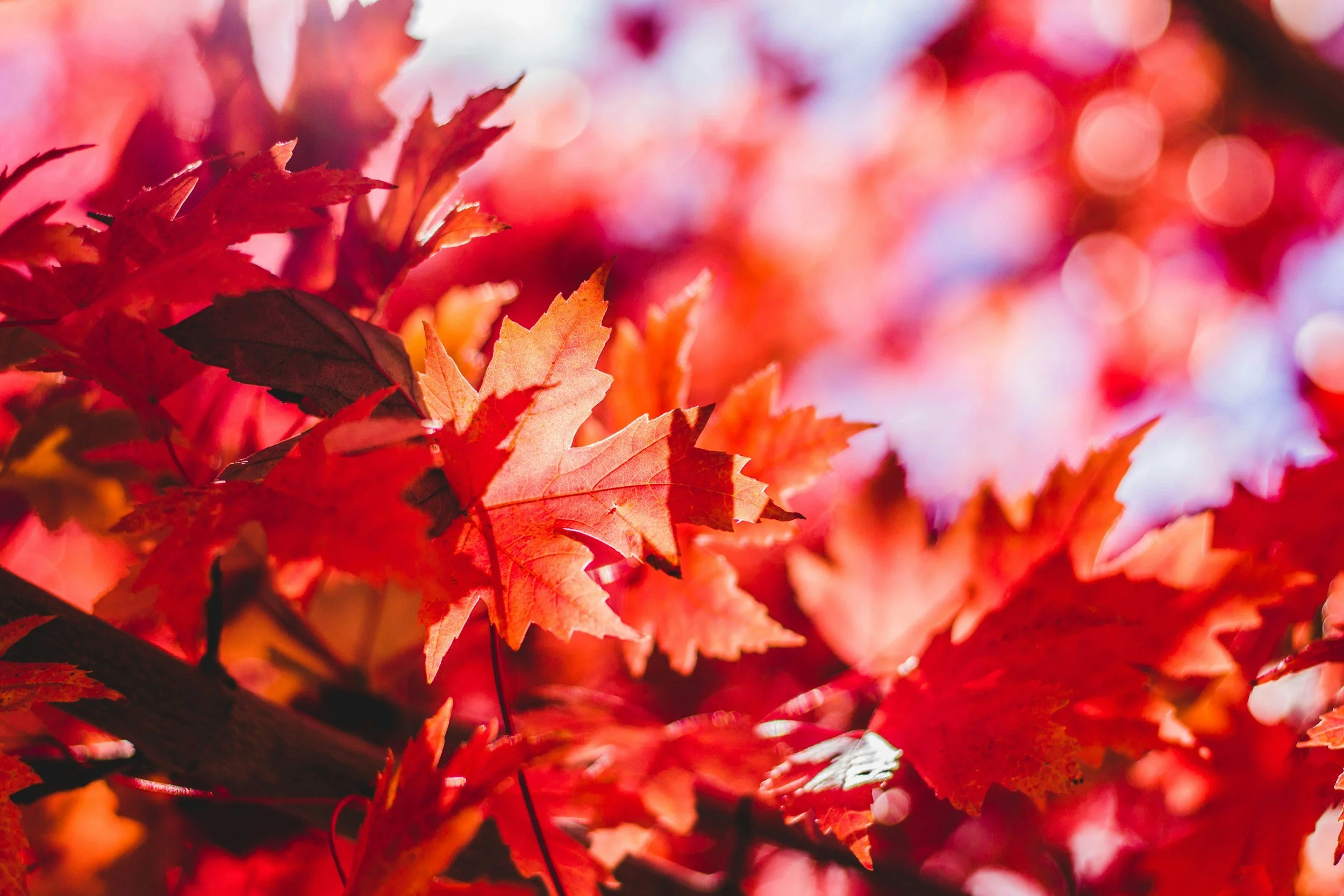
There is a morning in autumn when the light arrives at a different angle. You feel it before you know it — the crispness that enters cool through the nose and throat, the way the air asks you to stand taller, the particular hush that settles over the earth as it begins, quietly and without announcement, to turn inward.
Your body receives this before your mind does. Something in you that has nothing to do with thinking recognizes the season’s invitation and begins, already, to gather itself.
That is what I write in The Stirring. And I have found it to be reliably true, year after year: fall does not arrive as a concept. It arrives as a felt experience. The body knows first.
The question I want to explore with you today is: what does it know? What is fall actually inviting us into — and are we paying enough attention to receive it?
Fall Is the Season of Meaning-Making
In The Stirring, I describe how this book moves through the seasons of a life — not as stages to complete but as a rhythm to recognize, a quality of movement that each season makes possible and that the others do not.
Of fall, I write this:
“Fall — the season of meaning-making, of gathering what the year has grown, of understanding what can now be released, the crispness in the air that asks you to breathe in deeply and pay attention.”
Meaning-making. That phrase deserves to be held for a moment, because it is doing a lot of work. It does not mean explaining away what happened, or tidying the year into a lesson, or arriving at a conclusion that removes the complexity. Meaning-making, as I use it, means something more honest and more demanding than that: it means asking, with genuine curiosity and without rushing toward an answer, what has this season of my life actually been for?
Not what was it supposed to be for. Not what did I plan. But what has it, in fact, grown in me — and what is now ready to be harvested, examined, and either carried forward or released?
The Harvest Question
There is a practice I offer in The Stirring that I think of as the harvest question. It is not a journaling prompt so much as a quiet companion to carry across a few days. Not to be answered quickly or analytically, but held — the way you hold an apple in your hand before you decide whether it is ripe.
The harvest question is simply this:
What has this season grown in me that I have not yet had the stillness to notice?
It is a different question than how am I doing, or what do I want, or what should I do next. It asks you to look backward with curiosity before you look forward with intention — because the forward step is far more grounded when it comes from what is actually ripe in you rather than what you think you should want by now.
Fall makes this question available in a way that no other season quite does. The natural world is doing the same work all around you: bringing things to full color before they release, stripping back to essential structure, making visible the shape of things that summer’s fullness had concealed. You can let the season do some of the work simply by going outside, breathing the air, and allowing what you see to speak to what is happening inside.
What the Stripping Reveals
One of the central arguments of The Stirring is that the excavation — the process of going beneath the surface of a life to find what is most essentially true there — is what fall mirrors most faithfully. The leaves are not failing when they fall. They are completing something. And the tree, stripped of everything that is not its core structure, is not diminished. It is revealed.
I think about autumn and what it asks of the tree. The tree does not fight the stripping. It releases what is ready to be released, and what remains is exactly what was always most real — the branches, the architecture, the essential form that summer’s abundance had been growing toward all along.
“The autumn strips the tree to its essential structure. What remains is not less — it is what was always most real.”
This is the invitation fall extends to us as well. Not to manufacture a dramatic letting-go, not to force a reckoning, but to notice: what in my life has already done its work and is ready to release? What story have I been telling myself that is ready to fall away? What role, what habit, what way of being in the world has been serving as foliage — beautiful once, necessary once — but is now asking to be let go so that what is underneath can be seen more clearly?
These are not small questions. They are the questions of a season. And fall gives you the entire season in which to sit with them — unhurried, honestly, without needing to arrive anywhere before you’re ready.
Taking Stock Without Judgment
Taking stock is not the same as taking inventory. An inventory is a list. Taking stock is something more like a reckoning — an honest look at the whole of where you are, what has been growing, what has been costing you more than it gives, and what quiet truth has been trying to reach you through the noise of a busy life.
In The Stirring, I describe the stirring itself as exactly this: an internal knowing, not a thought you have assembled or a conclusion you have reasoned your way toward, but something that arrives from a deeper place than the reasoning mind. A recognition, felt in the body before it is named in language, that something is ready to move.
Fall is when the stirring often speaks most clearly. The busy-ness of summer quiets. The school year brings its rhythms back. The quality of the light changes in a way that feels, almost physically, like an invitation to go inward. And if you stop long enough to let it reach you — if you resist the habit of filling every quiet moment with noise or obligation — you may find that you have known something for quite a while that you simply haven’t let yourself say out loud yet.
“This is discovery, not itinerary. You take one step, understand something, sit with it. Then you take another. At some point, those understandings begin to gather into something larger — a seeing that starts to resemble the eagle’s view.”
Three Questions to Carry Into This Fall
I offer these not as a checklist but as companions for the season. Carry one at a time if that feels right. Return to the one that resists being answered — because resistance usually means something worth looking at is underneath it.
What has this year actually grown in you — not what you planned for it to grow, but what has, in fact, taken root?
What is ready to be released? Not what should be, not what you think you ought to let go of. What feels genuinely complete, finished, ready to fall away so that what remains can be seen more clearly?
What has the stirring been saying, quietly, beneath the noise of the months? What have you been almost ready to say out loud — and what would happen if you said it now?
You do not have to answer all three this week. Fall is patient. It gives you a whole season. The answers that matter most will arrive not in the effort but in the pause — on a walk, in the quiet before the day has asked anything of you yet, in the particular hush of an autumn morning that is not asking you to be anywhere other than right here.
Trust the season you are in. Every one of them belongs to the arc.
If something in this post has stirred something in you — if you are sitting with a harvest question you are ready to explore with some support alongside you — I’d love to offer a complimentary 30-minute conversation. No commitment. Just a place to begin.
Begin the excavation.
Schedule a complimentary 30-minute consultation — a no-commitment conversation to explore where you are and what this season might be asking of you.
catalystforrenewalstudio.com | pennsusan01@outlook.com
About Dr. Susan Sterkenberg
Dr. Susan Sterkenberg, PhD, is the founder of Catalyst for Renewal, based on Hilton Head Island, SC. She is the author of The Stirring: Excavating Your Authentic Self for the Life That Is Waiting and Becoming Sanctuary: One Mother’s Journey Through Seven Sacred Spaces of Grief, among other works. She brings 30+ years of coaching and organizational development experience to her practice.
CATALYST FOR RENEWAL | Monthly Blog
August 2026 | catalystforrenewalstudio.com
When Grief Comes Rushing Back —
Triggers, Emotions, and the Healing They Carry
By Dr. Susan Sterkenberg, PhD | Catalyst for Renewal
It had been ten years. I was sitting at a red light downtown, thirty minutes before a presentation, when I passed the art school where I used to drop him off in the mornings.
The memory arrived whole and complete — his face through the passenger window, my voice saying have a good day, his backpack over one shoulder as he headed toward the building. And I was a blubbering mess. Ten years out. Thirty minutes before I had to be professional and present for a room full of people.
That is what a grief trigger feels like. And if you have experienced one — whether it’s been six weeks or six years since your loss — you know exactly what I mean.
No One Warned Me About Triggers
In Becoming Sanctuary, I write honestly about this: no one warned me adequately about triggers. Or perhaps they did, and I simply couldn’t have understood in advance what they would actually feel like — that particular ambush quality, the way they arrive without announcement and drop you, without warning, back into the heart of the worst of it.
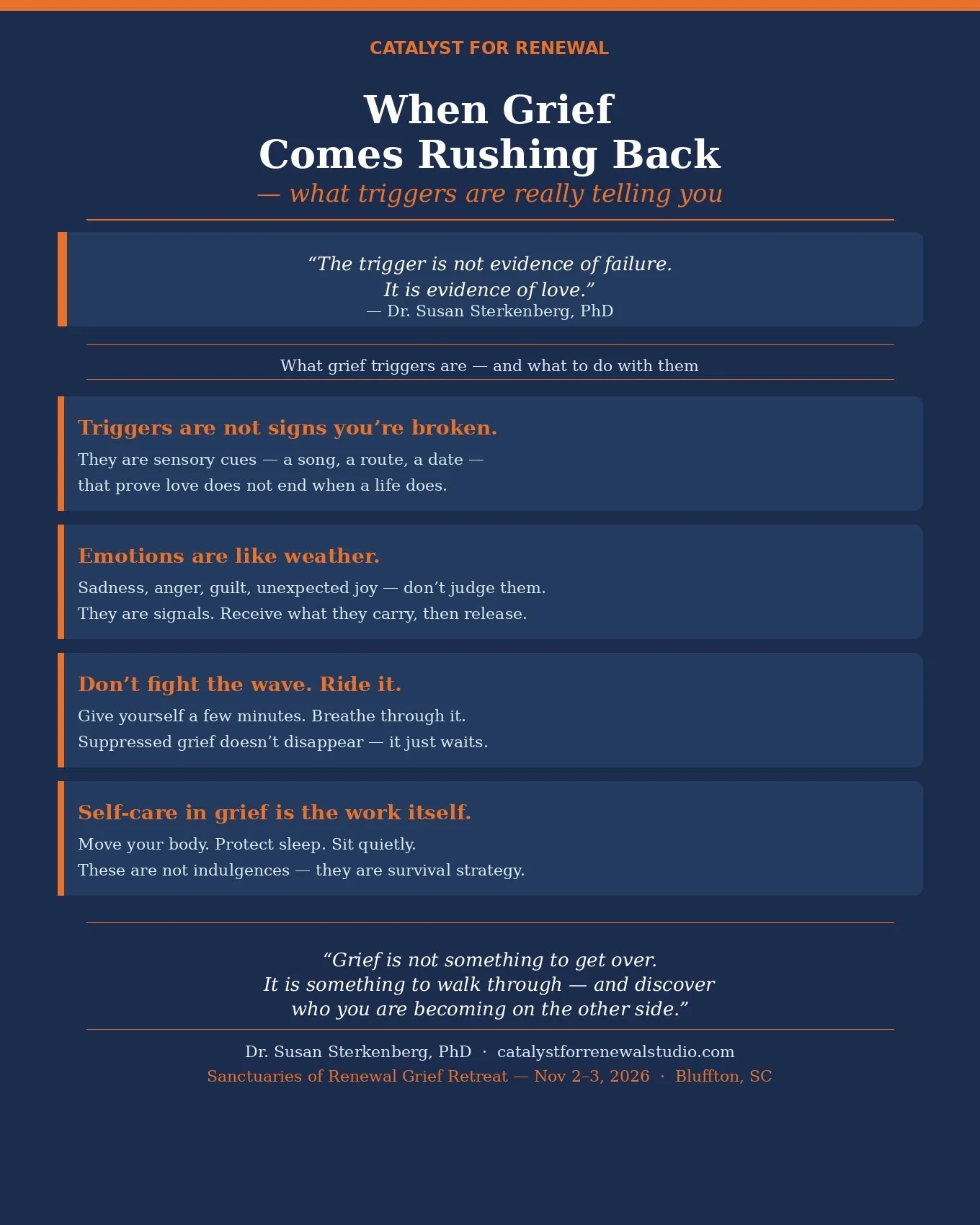
A song on the radio. A young man who moves through space the way your person moved. The route you used to drive. A birthday on the calendar. A holiday table set one place short. These are not signs that something is wrong with you, or that your grief is stuck, or that you haven’t healed. They are proof that you loved someone completely — and that love does not end when a life does.
“The triggers soften in their frequency, in their intensity, in how long they last. But they don’t disappear entirely, and you don’t need them to. Each one is a moment of contact. A proof that love persists.”
What no one tells you is this: triggers can arrive with the same force years later as they did in the early days. Not always. Not even often, as time passes. But they can. And when they do, it is not regression. It is love, surfacing. It is the indelible mark your person left on the ordinary geography of your days.
Emotions Are Not the Enemy — They Are the Messenger
One of the most important reframes I offer in grief work — and in The Stirring, where I explore emotional intelligence and self-care more broadly — is this: emotions are like weather.
We do not judge a storm for arriving. We do not tell ourselves something is wrong with the sky because it is raining. Weather simply is what is present — information about current conditions, not a verdict on the forecast forever. Our emotions work the same way. They are not character flaws. They are not evidence of weakness or failure to cope. They are the body’s honest signal system, alerting us to what is alive within us.
In grief especially, this reframe matters enormously. The wave of sadness that hits at a birthday dinner is not a sign that you are broken. The unexpected rage at a quiet moment is not proof that something has gone wrong. The guilt that rises when you laugh at something funny — that tender, complicated guilt — is love asserting itself, worrying that joy means forgetting. It doesn’t. But the feeling deserves to be received, not suppressed.
“Fighting a trigger is like trying to fight a wave. The wave is stronger. Better to go with it, feel it fully, and find your footing again on the other side.”
When we judge our emotions — when we tell ourselves we shouldn’t feel this, or we’re taking too long, or others have had it worse — we cut off the very signals that the healing process depends on. The emotion is trying to tell us something. Our work is to let it speak.
Self-Care Is Not Optional in Grief — It Is the Work
When a trigger hits, the body needs tending. Not performance. Not pushing through. Tending.
Give yourself a few minutes. Pull over if you’re driving. Step outside if you’re in a building. Let the wave come, breathe through it, and then gather yourself and go back in. You cannot prevent triggers. But you can learn to ride them with a little more grace over time — and the grace begins with giving yourself permission to feel what arrives without apology.
Beyond the moment of a trigger, grief asks for consistent, whole-person care: moving the body so the nervous system has somewhere to metabolize what the mind cannot yet process. Walking the same path repeatedly, because repetition is medicine when the world feels chaotic. Eating with attention. Protecting sleep. Sitting quietly without a task. These are not indulgences. They are, as I write in Becoming Sanctuary, survival strategy. They are how you make it through days that feel impossible.
And they are part of the healing journey — not detours from it. Every act of genuine self-care is a statement that your life still matters. That you are still here, still capable of being tended and restored. That is not small. That is everything.
An Invitation to Go Deeper This Fall
If you are carrying grief — whether it is new or years old, whether it feels stuck or simply unfinished — I want you to know that you do not have to walk this alone. And sometimes, the most powerful thing we can do is step away from ordinary life for a few days and give grief the space and witness it has been waiting for.
This November, I am hosting the Sanctuaries of Renewal Grief Retreat in the Low Country — a two-day immersive experience at May River Manor in Bluffton, South Carolina, grounded in the Seven Sanctuaries framework from Becoming Sanctuary. Every element is research-backed: continuing bonds theory, somatic healing, expressive arts, peer witnessing, nature immersion, and ritual ceremony. It is grief work done in beauty, in community, and with professional guidance.
Sanctuaries of Renewal Grief Retreat
May River Manor | Bluffton, South Carolina
November 2–3, 2026 (Sunday November 1 arrival & welcome)
Early bird: $795 | After September 1: $995
Includes all meals, materials, Becoming Sanctuary book, and one year of monthly Grief Group (virtual)
Register: catalystforrenewalstudio.com | pennsusan01@outlook.com
Whether the retreat calls to you or you simply want to talk — a complimentary 30-minute consultation is always available. Reach out at pennsusan01@outlook.com or visit catalystforrenewalstudio.com.
About Dr. Susan Sterkenberg
Dr. Susan Sterkenberg, PhD, is the founder of Catalyst for Renewal, based on Hilton Head Island, SC. A grief transformation coach with a doctorate in psychology and 30+ years of experience, she is the author of Becoming Sanctuary: One Mother’s Journey Through Seven Sacred Spaces of Grief and The Stirring: Excavating Your Authentic Self for the Life That Is Waiting.